
The below is for families who already have a general understanding of how NYC kindergarten admissions work. If you’re looking for a full breakdown of the process, including how students receive a placement, read our full Guide to NYC Public Kindergarten Admissions and blog post, What do I do if I don’t want to send my child to our zoned elementary school?
This week in NYC, there was a lot of kindergarten admissions “playground chatter.” Offers were released on Tuesday, April 1, and for some families, the news was surprising—and disappointing. Instead of receiving an offer to their zoned school, they were waitlisted and placed elsewhere.
How is that possible? And what does it actually mean for your family? Let’s break it down.
Are you guaranteed your zoned school in NYC kindergarten admissions?
In the words of the NYC Department of Education: “Most zoned schools make kindergarten offers to all students living in the zone.”
In other words: no, it is not guaranteed.
There are no tricks or hidden strategies, this is a mere numbers game. When there are more in-zone applicants than available seats, some students will be waitlisted at their zoned school and placed at a school with open seats. If a school on your application list has a seat for you, there’s your match. However, if every school on your list is filled with students from higher priority groups or with a strong random admissions number (RAN or “lottery number”), you will be placed at a kindergarten program with available seats. This “random” placement will factor in geography, but may be in a different school district, and, even, borough.
Some comforting news – while these situations tend to get a lot of attention in parent groups, they are relatively rare and typically occur at a small number of highly sought-after schools in densely populated neighborhoods.
How can I improve my NYC kindergarten placement chances?
For many families, if you are happy with your zoned school, your search can begin and end there. It really is that simple. However, if you are concerned about overcrowding, or simply want more control in the process, your application list matters. List multiple options on your child’s application, including other schools in your district with open seats.
Your school list is your leverage.
The scenario families often worry about—being placed at a “random” school— only happens when none of the programs on an application have available seats.
To avoid this:
List multiple programs
Include other schools in your district
Include city-wide or district-wide programs
Consider adding at least two programs that historically has open seats
Even if it’s not your top choice, having a known option on your list is often preferable to an unknown placement.
What happens if you are waitlisted at your zoned school in NYC?
First, know that waitlists do move.
Students are ordered by a waitlist number (separate from your admissions “lottery number”), and as families finalize plans over the spring and summer, seats can open up. Schools do initially overoffer, so one family un-enrolling does not mean a waitlisted family’s offer, so some patience is required.
If you are strongly committed to your zoned school:
Stay on the waitlist through summer and the first week of school
Reach out to the school’s parent coordinator to express continued interest
While schools cannot bypass the waitlist, they can sometimes encourage families ahead of you to finalize their plans, which can help the list move more efficiently.
At the same time, it’s important to get to know your current placement. Connect with other families and begin to picture your child there—you may find it’s a better fit than expected.
Is my younger child guaranteed a spot at the same school as my older child?
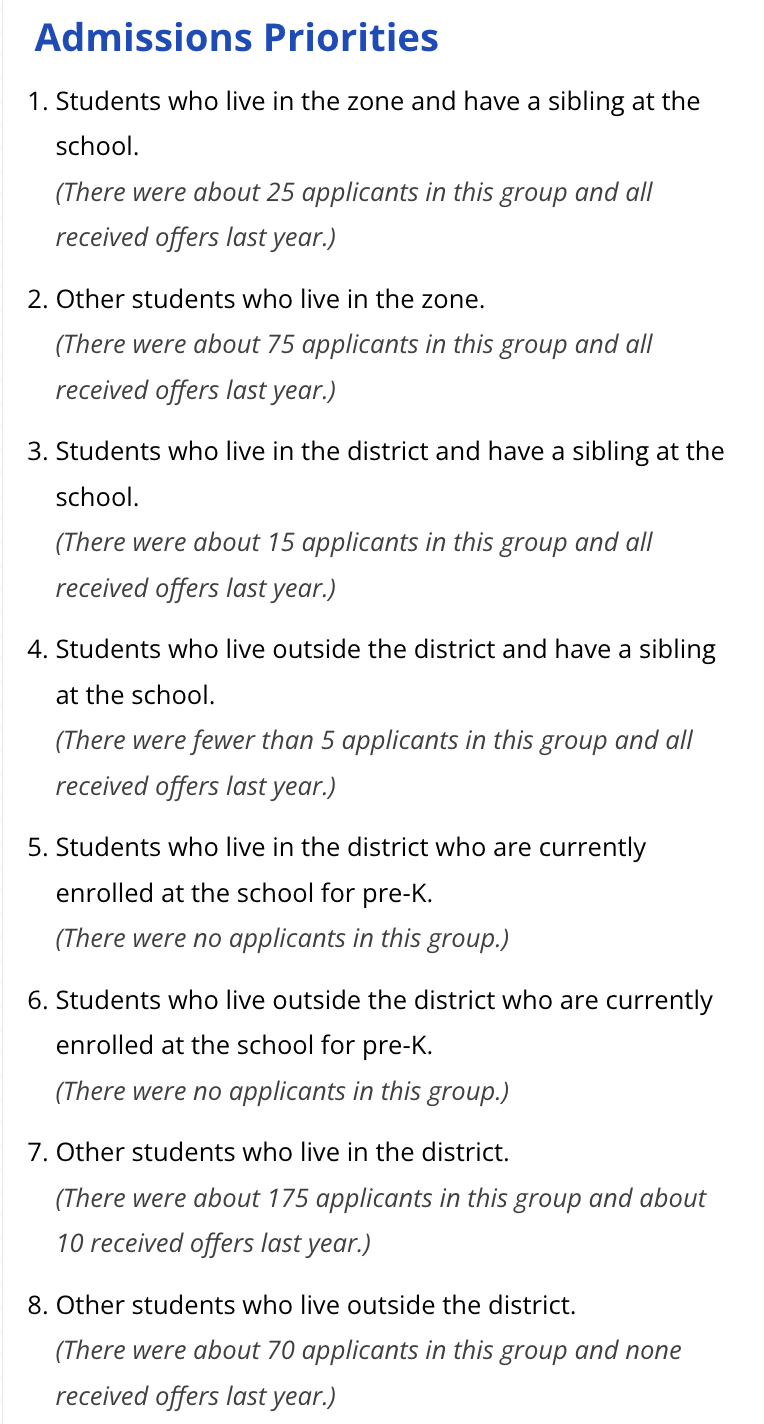
Not necessarily.
Schools admit students based on priority groups. While sibling priority is a factor, it often comes after in-zone priority.
In most cases, schools will:
Admit in-zone students
Then consider out-of-zone students with siblings
Then other applicants
There may also be district priorities layered in, depending on the program. To the right is an image of the priority groupings at a typical zoned elementary school.
For families who didn’t receive their expected placement this week, it can feel unsettling. But in most cases, this is not a sign that something has gone wrong, it’s simply how a complex system manages limited seats. With a clear understanding of how placement and waitlists work, you can make informed decisions, stay flexible, and move forward with a plan that feels grounded and manageable.
Related Reads:
Parent’s Guide to NYC Public Kindergarten Admissions
What do I do if I don’t want to send my child to our zoned elementary school?
Still have questions? Want to talk through your NYC Kindergarten admissions plan? BetterEd is here to help. You know your child, we know education. Sign up for a consultation below or contact us for more information.