
If you are reading this, congratulations! You are embarking on a process we truly love – finding a school for your soon-to-be elementary schooler. Before you enter a state of stress and feeling overwhelmed, keep in mind that tens of thousands of families successfully navigate this process year after year. Yes, there are a wide range of options and some strategic “know-how,” but you can and will find a great public Pre-K program for your child. Having school choice is an opportunity!
Here are a few positive guiding principles to keep in mind:
The Pre-K process is straightforward, and you will understand it.
There are many wonderful free pre-K options across NYC (there is probably more than one within walking distance of your home!).
The NYC DOE places every applicant in a public Pre-K program.
Here is the catch:
Yes, the NYC DOE works to place every applicant in a public Pre-K program, but you are not guaranteed a seat at a particular school – or even one of the programs on your application.
Even if you have your heart set on that charming public school down the block, there is no way to guarantee placement at your top choice. In some neighborhoods, demand exceeds the number of available seats. You may need to cast a wider net than you anticipated, but there are many wonderful free Pre-K options across NYC. The key is understanding how admissions work and building an application that balances your family's preferences with realistic alternatives.
Overview NYC Pre-K Programs
How do you apply for Pre-K in NYC?
Applications take place during the school year prior to your child’s entry.
Fall: Create a MySchools account and begin exploring programs.
MySchools is your application portal, but it is also where you can explore different Pre-K programs. Play around with filters in the MySchools directory to get a sense of nearby programs.
Winter: Attend tours or open houses .
Tours can help you get a feel for a program, but attending does not give you admissions priority.
Mid-January: Open your MySchool application.
Your child will receive their Random Admissions Number (RAN), which is sometimes referred to as their “lottery number”.
By the end of February: Rank programs in order of preference in MySchools.
You can make changes until the application deadline.
Mid-May: Receive your offer and waitlisted spots.
Families receive one placement at the highest-ranked program able to admit them based on priority groups and lottery number. If no program on your list has seats, you will receive a placement at a program not on your list. You are automatically waitlisted at any program on your list ranked higher than your placement. You are given a new random number for waitlist placement, in other words, if you have an unlucky lottery number there is a chance you could have a strong waitlist number.
Important: Pre-K admissions are not first-come, first-served, so submitting early does not improve your chances.
What are the types of Pre-K programs in NYC?
There are three different types of Pre-K settings. Though it is helpful to understand the difference between setting types, all three follow the same play-based curriculum and adhere to the New York State Pre-K Learning Standards.
When choosing a Pre-K, we recommend exploring a range of programs and focusing on the individual program itself, rather than making assumptions based on its setting. The different settings may look and feel quite different, but one type is not inherently better than another. What matters most is finding a program that feels like a strong fit for your child and your family, which will be determined by your personal values and priorities (convenience, educational philosophy, availability of after school care, etc).
District Public School Programs
Some elementary schools (typically those that serve students through 5th grade) offer Pre-K classrooms within a traditional school building. Families who are thinking ahead about continuity into later grades often explore these options. It is always worth checking whether your zoned elementary school has a Pre-K program.
NYC Early Education Centers (NYCEECs)
These are community-based organizations that partner with the DOE. They may look like private preschools or daycare centers, but provide a number of free seats through the public school system. Many also offer extended hours for an additional fee. Goddard, Bright Horizons, All my Children, and Manhattan Schoolhouse are examples of EEC’s with multiple locations that have 3-K and Pre-K programs.
Pre-K Centers
These are DOE-run buildings that serve only early childhood students, typically offering both 3-K and Pre-K. These settings are specifically designed for younger learners.
What about G&T programs?
Gifted and Talented programs begin in Kindergarten, so if you are just beginning your Pre-K search, G&T is not something that needs to factor into your school decision.
Pre-K Seat Types
There are three seat types, and when you apply to programs you are applying for a specific seat-type, which are ranked separately in your MySchools application. Not every program offers every seat type. All the information on a school’s seat options and eligibility requirements is available through the MySchools search tool.
School Day seats
Free for all NYC families
About 6 hours and 20 minutes per day during the school year
Extended Day & Year seats
Free or low cost for some NYC families based on family income and need
Up to 10 hours of care year-round
City Transitional seats
Free for some NYC families based on income and need
Up to 10 hours of care year-round
Understanding Priority Groups and the NYC Pre-K Lottery
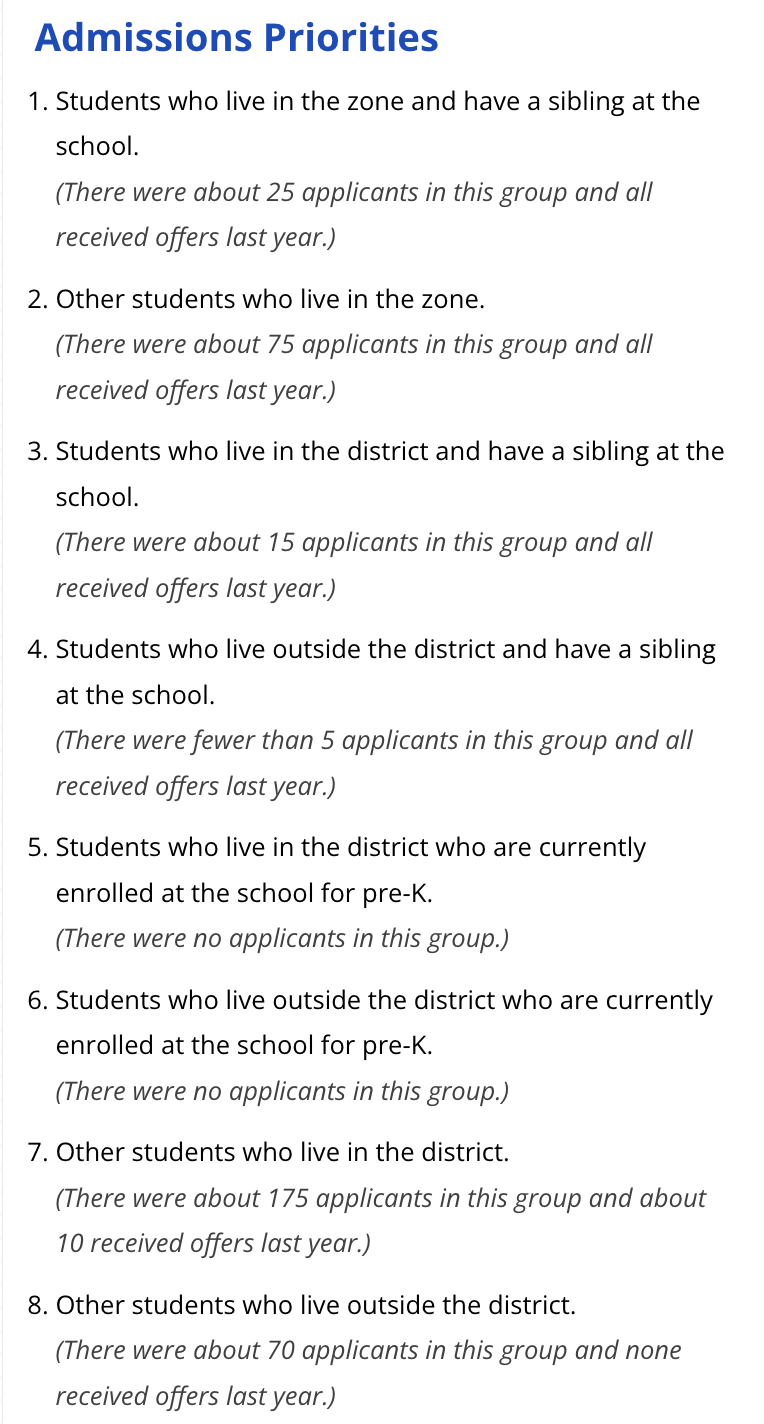
You will fall into exactly one priority group per program. Programs admit students in order of priority.
How do NYC Pre-K programs choose who is admitted?
Pre-K programs admit students according to specific priority categories. Common priorities include:
Children already attending the program's 3-K or other three-year-old class
Children with siblings attending the school or center
Families living within the school's zone or district
Applicants who qualify for specific priorities through the city's Diversity in Admissions initiatives
Each applicant falls into one priority group for each program. Programs make offers by admitting students in priority order, meaning applicants in higher priority groups are considered first. Check the admissions priorities listed for each program in MySchools.
NYC Pre-K Zoned Priority:
If your zoned elementary school offers a Pre-K program, you will have priority to attend that program. However, it is important that admission is not guaranteed. Typically, first priority is given to students who also have siblings enrolled at the elementary school and often there are not enough available seats to accommodate all in-zone applicants. You can always check the number of seats available and admissions odds (based on last years admissions cycle) on the MySchools website.
Understanding Random Admissions Number (RAN)
Your Random Admissions Number (RAN), often called a “lottery number,” is one part of the admissions process. Your child's chances depend on the program's available seats and admissions priorities, as well as the number assigned to their application when applicants within a priority group must be distinguished. You can think of your RAN as your place in line among applicants who fall into the same priority group. Your RAN is not your fate: outcomes vary from program to program, depending on demand, available seats, and your child's priority.
How to Rank Programs: Top Tips for Your NYC Pre-K Application
Your child receives one offer, based on:
Your ranked application choices
Each program’s seat availability
Admissions priorities
Your child’s Random Admissions Number (RAN)
Rank in your true order of preference:
Schools cannot see how you ranked them, and ranking order does not affect your admissions priority.That means the best strategy is simple: rank programs in your true order of preference.
You are not penalized for ranking a popular program first, and you cannot improve your chances by trying to “game” the system. The admissions algorithm simply matches your child to the highest-ranked program that is able to offer them a seat.
Cast a wide net:
Unlike Kindergarten, most families do not attend a Pre-K family at their zoned school, so applying broadly can help. Keep an open mind and consider a range of programs you would genuinely be willing to attend. Think about more than a school's reputation: location, daily schedule, classroom environment, and the practicalities of drop-off and pick-up all matter. Including a broader range of programs you would be happy with improves your chances of receiving an offer from your application list rather than being offered a program you hadn't considered.
Planning ahead and why it matters:
As noted in the priority groups section, schools often give priority to continuing students. In other words, if your child is already enrolled in a program for 3-K , they may fall into a higher priority group when applying to that program’s Pre-K’s class. Furthermore, the same holds true for 3-K programs – if you are enrolled at a program for 2s, you likely have priority for a 3-K seat at that program. This priority system is partially the root of the planning ahead mayhem that you likely have absorbed from families with young ones not yet ready for school. When families are enrolling in a twos program it is often already with Pre-K in mind. However, if you are feeling behind, don’t worry, there are very likely multiple Pre-K options in your district that have a seat for non-continuing students.
What about Kindergarten?
All NYC residents are guaranteed a Kindergarten seat, regardless of where their child attends Pre-K. If your zoned elementary school or another nearby elementary school has a Pre-K program, it is absolutely worth exploring and ranking highly if it feels like a good fit for your family. However, your placement at your zoned elementary school is not heavily dependent on your Pre-K placement. The vast majority of zoned Kindergarten programs are able to offer seats to all their in-zone applicants, not just those who attended the Pre-K program.
Offers, waitlists, and what happens next:
When results are released in the spring:
You will receive one offer.
Your child will automatically be waitlisted at any programs ranked higher than your offer.
You can also join additional waitlists.
Programs contact families directly if seats open later in the spring or summer. Waitlists often move throughout the summer, so it’s worth staying engaged. If you are highly interested in a program where your child is waitlisted, you can reach out to the school’s parent coordinator or admissions director. They may be able to share general information about waitlist movement or the likelihood of placement.
NYC Pre-K admissions can feel overwhelming at first, but keep those positive guiding principles in mind: there are many wonderful free Pre-K options across the city, and the city offers a Pre-K seat to every four-year-old that applies. You may not have a guarantee at your top choice programs, but understanding how priorities, program types, and rankings work allows you to approach the process with clarity and an open mind.
With thoughtful research and a well-planned application, you can explore a range of options and increase your chances of finding a program that works for your child and your family's daily routine.
Still have questions? Want to talk through your NYC Pre-K admissions plan? BetterEd is here to help. You know your child, we know NYC Schools. Sign up for a consultation below or contact us for more information.